How to Test an Automation Before Running It
Run it once, on purpose, and read what comes out. Five things to check before you let a workflow fire on its own schedule.

Quick guide
Use Test on the canvas to run the workflow once, now. Read every step's output rather than only the final one, check the branch went the way you expected, and make sure any publish is behind an approval step before you activate.
- Press Test in the canvas header to run the workflow once.
- Read what each step produced, not just the end of the run.
- Check the branch took the path you expected for today's data.
- Check that nothing published that should have waited.
- Fix, test again, and only then activate.
The full walkthrough is below.
An untested workflow is a guess with a schedule attached. Testing takes two minutes and catches the two mistakes everybody makes.
Run it once
The canvas header has a Test control. It runs the workflow now, once, with your real data, and shows you what each step produced.
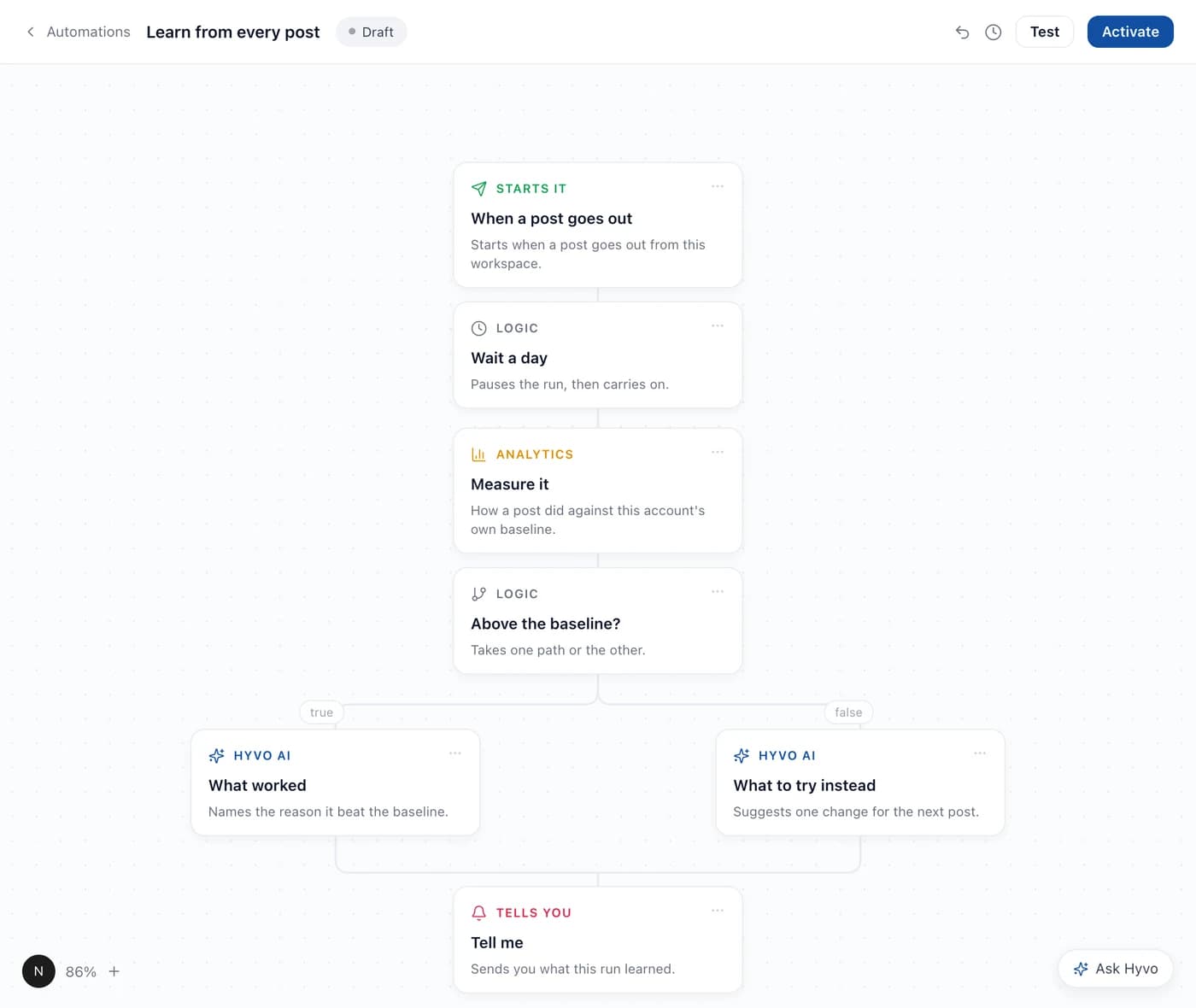
Real data matters. A test against made up numbers tells you the workflow runs. A test against your actual last week tells you whether the output is worth receiving.
The five things to check
1. Did every step run?
A run that stops halfway is telling you something, and the step it stopped on is usually the one asking for data that is not there yet. A workflow that measures performance needs published posts to measure. On a new account there may be nothing.
2. What did each step produce, not just the last one?
The final output can look fine while a step in the middle did the wrong thing and got lucky. Read the intermediate steps, especially anything using Hyvo AI, because an analysis step that misread the brief will produce a confident, plausible, wrong summary.
3. Did the branch go the way you expected?
If your workflow has a logic step, it went down one of two paths today. Which one, and was that right?
The path you did not take is the one that will bite you, because it will fire in three weeks when you are not watching. If the "below baseline" branch is empty, the run that goes down it produces nothing and you will assume the automation is broken.
4. Did anything publish?
This is the important one. If the test published a real post to a real account, and you expected drafts, your approval step is missing or in the wrong place.
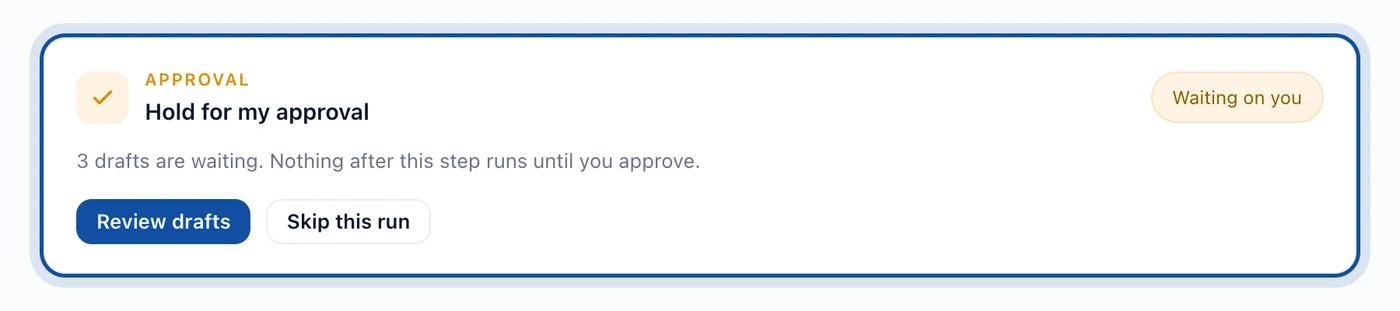
Move the approval step and test again.
5. Would you have read the output?
The quiet failure. A workflow that runs perfectly and produces a summary you skim and close is costing you attention every week for nothing.
If the answer is no, the fix is usually the brief rather than the workflow: ask it for one specific thing instead of a general summary.
When a test fails
A failed run says which step failed and why.
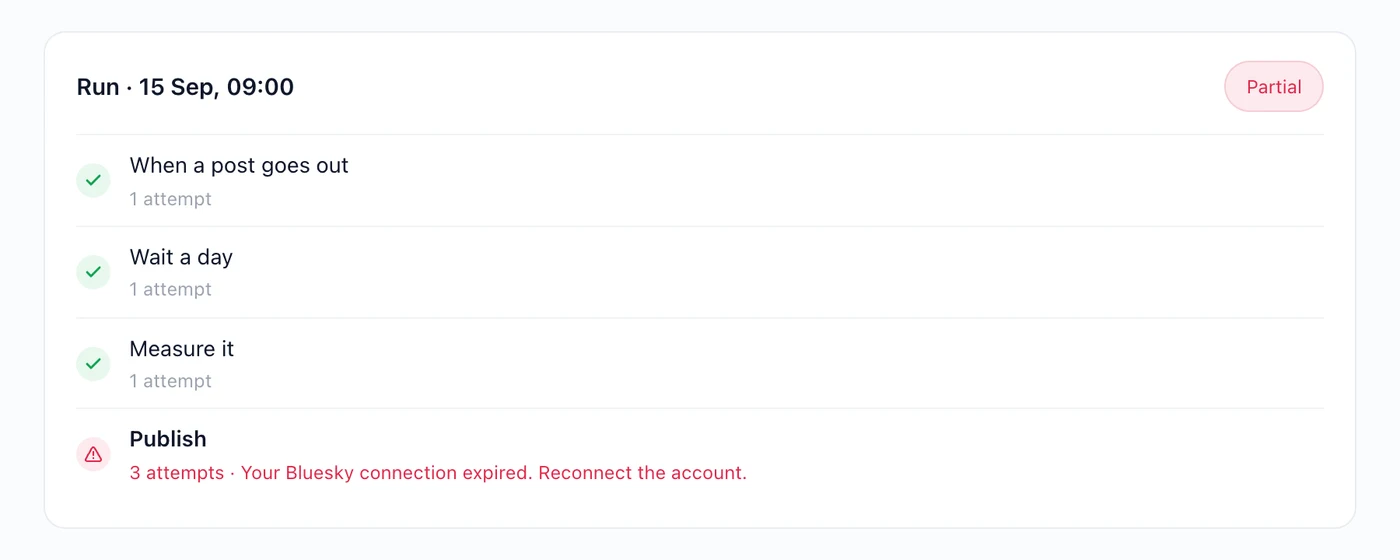
Most first run failures are one of three things: an account that needs reconnecting, a step asking for data from a period with no posts in it, or a condition written against a metric that particular network does not report. LinkedIn and Facebook, for instance, return no reach figure, so a branch that tests impressions will never be true for them.
Why did my automation fail? goes through the causes properly.
Turn the automation on
Once a test produces something you would have been pleased to receive on a Monday morning, activate it. Then look at the first two real runs. After that you can stop watching.
FAQs
Does a test run use my real accounts?
Yes. It reads your real data, and if the workflow contains a publish step with nothing in front of it, it will publish. That is why the approval check matters.
Does a test count against my plan limits?
A test run does the same work as a real run, including any AI steps, so it uses the same allowance.
Can I test one step instead of the whole workflow?
Test runs the workflow. Reading each step's output afterwards is how you check an individual one.
What if there is no data yet?
A workflow that measures performance needs published posts. On a new account, publish for a couple of weeks first, then test.
How often should I retest?
After any edit to the workflow, and any time it starts producing something that looks off.
About the author

Founder, Hyvo
Subarna Basnet is the founder of Hyvo, an AI-powered platform helping businesses create, manage, and automate social media marketing. He writes about AI, social media automation, content creation, and marketing technology.