How to Create Platform-Specific Social Media Content
What actually travels between networks, what has to be rewritten, and how to do the rewriting in minutes rather than treating each channel as a separate job.

Quick guide
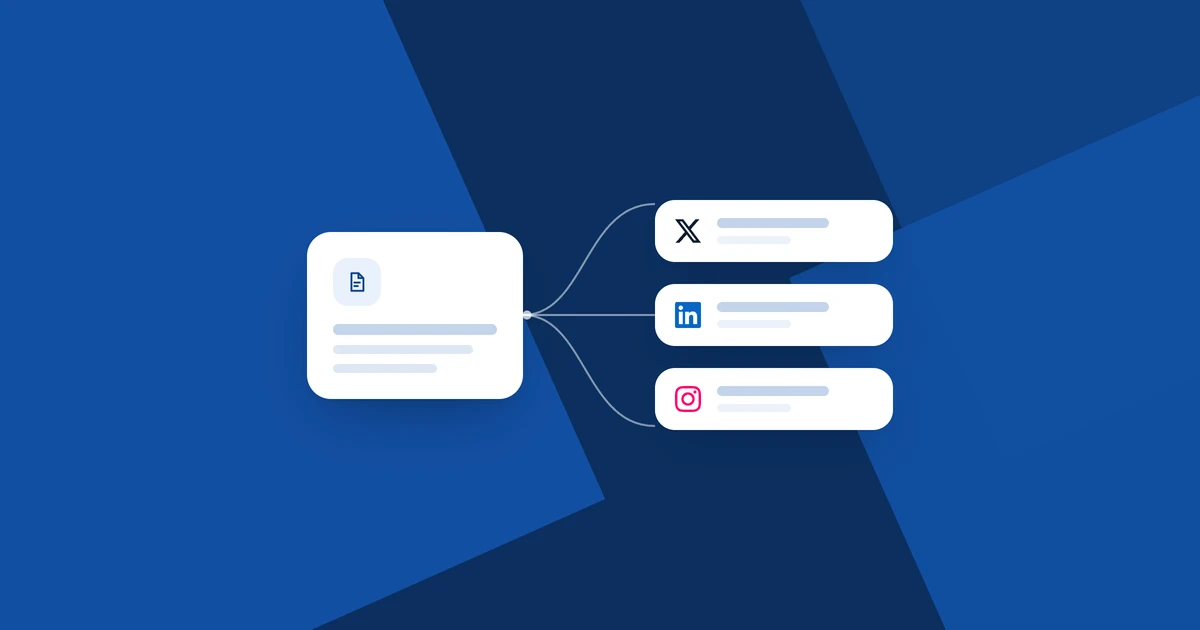
The idea travels. The wording, the length, the opening and the format do not. Write the idea once, then rewrite the opening and the length per channel, which takes a couple of minutes each and is the difference between syndication and publishing.
- Write the idea in whatever form comes naturally first.
- Decide the one sentence that has to survive on every channel.
- Rewrite the opening for each channel. This matters more than the body.
- Cut to the limit rather than letting the network truncate.
- Check the format each network needs before you schedule.
The full walkthrough is below.
Cross posting the identical text everywhere is the most visible shortcut in social media. Everyone can tell. A LinkedIn post pasted into X is over the limit and gets cut; an X post pasted into LinkedIn looks like someone could not be bothered.
But writing four genuinely separate posts for one idea is also wrong, because it is four times the work for one thought. The right answer is in between and it is mostly mechanical.
What travels and what does not
Travels: the idea. The claim, the story, the number, the point you are making.
Does not travel: the opening line, the length, the formatting, the register, and the format itself.
That split is the whole method. You are not writing four posts. You are writing one idea and four openings.
The opening is the part that matters
If you only adapt one thing per channel, adapt the first line.
The first line does all the work on every network, and what a good first line looks like differs completely:
- On X, it has to be the whole point, because there is a decent chance nobody reads line two. 280 characters means the post is the hook.
- On LinkedIn, the first line is the only thing visible before "see more". It has to earn the click, and it is usually a claim or a tension rather than a summary.
- On Instagram, the image is the hook and the caption's first line is the second hook, for people who already stopped.
- On Threads and Bluesky, shorter and more conversational than X, and both punish anything that reads as marketing copy.
Same idea. Four different first lines, each of which takes about thirty seconds once you know what the idea is.
Length: cut, do not truncate
Every network has a limit and they are nowhere near each other:
| Network | Limit |
|---|---|
| X | 280 |
| Bluesky | 300 |
| Threads | 500 |
| 500 | |
| Mastodon | 500 |
| 2,200 | |
| TikTok | 2,200 |
| 3,000 | |
| 63,206 |
Networks do not trim politely. They reject the post or cut it mid sentence. So the short version has to be written as a short version, not as a long version with the end removed.
Cutting to 280 is a skill worth having, because it forces you to find the actual sentence. Plenty of long posts turn out to be one good line and four hundred words of throat clearing.
Format is a hard constraint, not a preference
Three networks will not take a text only post at all. Instagram and Pinterest need an image, TikTok needs a video. There is no short version, no workaround and no exception.
This matters at the planning stage rather than the publishing stage. If an idea has no visual and you cannot make one, it is not an Instagram post, and deciding that on Tuesday is much cheaper than discovering it at nine on Friday when the publish is blocked.
Register: the same person, a different room
The tone should not swing wildly between channels, or you are not one brand, you are four.
But the same person does talk differently in different rooms, and pretending otherwise is its own kind of tone deafness. Slightly more formal on LinkedIn, faster and drier on X, warmer on Instagram. Same voice, different volume.
The thing that keeps this coherent is having written your voice down somewhere: how you sound, what you never say, which words are yours. Otherwise each channel drifts on its own and after six months they are unrelated.
A workflow that takes ten minutes
- Write the idea properly once, in whatever form is natural. Usually the longest channel.
- Underline the one sentence that must survive everywhere.
- Write the X version from that sentence, from scratch, not by cutting.
- Write the opening line for each other channel.
- Attach media where the network requires it.
- Read the shortest version out loud. If it does not stand alone, it is not finished.
Ten minutes for four channels, and the reason it is ten and not forty is step one: the thinking happened once.
Where a tool helps
Cutting a paragraph to 280 characters without losing the point is exactly the kind of mechanical, well defined task worth handing to an assistant. So is turning a formal line into a conversational one.
What is not worth handing over is step two, deciding which sentence has to survive. That is the judgement, and it is the part that makes the post yours.
If you are doing this in Hyvo, the composer holds a version per channel on one draft and counts characters against each account's own limit, so the shortening happens while you write rather than after something is rejected.
FAQs
Is cross posting always bad?
No. Text posts on X, Threads, Bluesky and Mastodon are similar enough that one version often works on all four. The mistake is treating LinkedIn and X as interchangeable.
How different should the versions be?
Same idea, different opening and length. If the versions say different things, you have written two posts and should schedule them separately.
Do hashtags travel?
Barely. They still do work on Instagram and Pinterest, do very little on LinkedIn and X, and read as noise on Bluesky and Mastodon.
What about posting the same thing at different times?
That is a reasonable tactic within one network for different time zones. It is not a substitute for adapting between networks.
Which channel should I write first?
The most constrained one you are posting to. Writing the 280 character version first forces the idea into its clearest form, and expanding is easier than cutting.
About the author

Founder, Hyvo
Subarna Basnet is the founder of Hyvo, an AI-powered platform helping businesses create, manage, and automate social media marketing. He writes about AI, social media automation, content creation, and marketing technology.